


Secure Hardware Lab
lowRISC® are the stewards of the Secure Hardware Lab, a new open platform for hardware security research, created with support from the UK government and comprising:
The Secure Hardware Lab will be created with support from CSIT (Queen’s University of Belfast) and CHIMES2 (University of Sheffield). It will provide two major benefits to hardware security researchers:
-
Access to physical implementations of secure chips with known digital and analog designs, for security assessments
-
Easy modification of the reference designs, and low-cost access to tools and tapeouts to evaluate, prove and demonstrate new technologies
The Secure Hardware Lab will not only provide the chip design, but also a range of complementary deliverables:
Reference design 1: Espresso
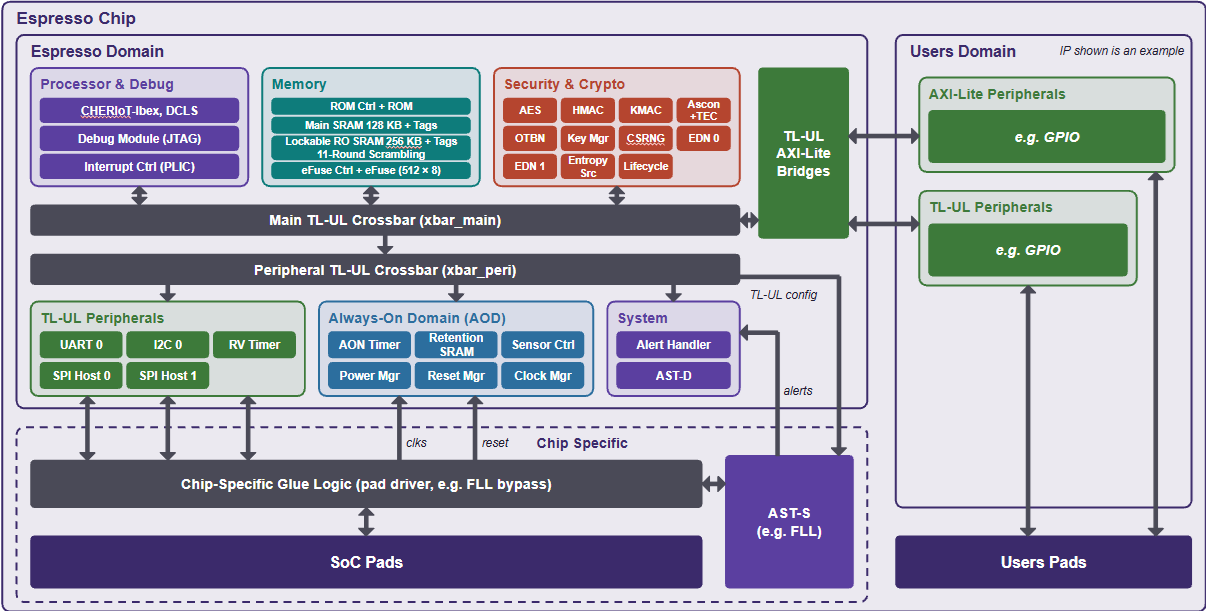
The first reference design provided by this platform is called Espresso. This is a simple security-hardened discrete RoT design: a subset of OpenTitan Earl Grey 2.
Espresso is ideal to enable security assessment of a mature RoT implementation, where both the design data and chip are provided.
In addition, thanks to its small design, Espresso enables a low-cost and simple way to prototype new technologies such as PUFs, memories and random number generators.
Reference design 2: Macchiato
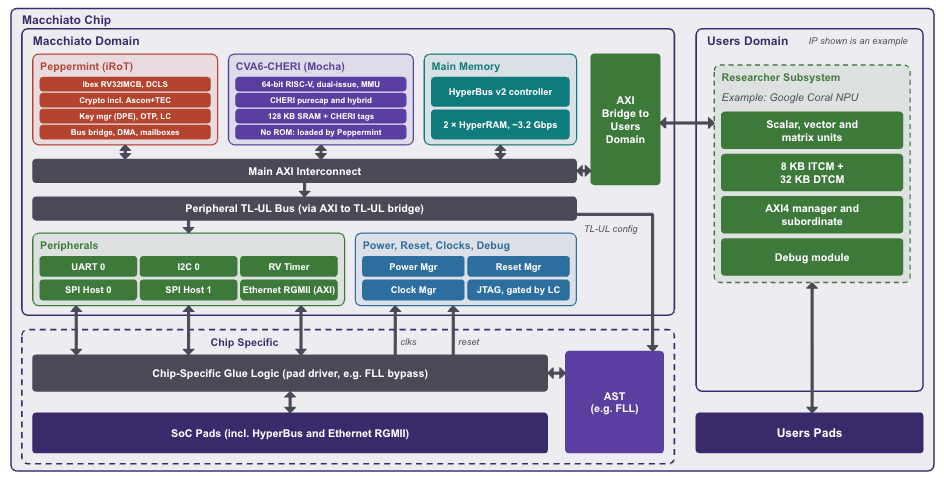
In 2027 we will start work on Macchiato, a reference design for a secure SoC.
Macchiato is a significantly more complex design, with a Linux-capable compute subsystem based on CVA6-CHERI and an integrated RoT component based on OpenTitan Peppermint.
Macchiato will enable a new range of research projects that consider the security across a complete SoC, including the integration of the RoT, the security of AI accelerators and workloads, as well as confidential compute on RISC-V CHERI.
Interested in Secure Hardware Lab?
Secure Hardware Lab governance
lowRISC® are the stewards of the Secure Hardware Lab, responsible for the success of this project. In that role, lowRISC has multiple duties:
-
Implement and maintain the legal framework for the project, ensuring that users of its IP are protected against IP risk
-
Run the collaboration forums for the project – governing board, technical committee and working groups – and engage with a wider range of stakeholders
-
Ensure the quality of the technical implementation with its maintainers and verification team
-
Continuously improve its engineering infrastructure, enabling fast and effective contributions
lowRISC is in an ideal position to perform this role by virtue of it being a CIC, and because it has a large team continuously doing design, verification and software development work for the project.